


The Ultimate Guide to Modern Construction Materials in Delhi NCR: Selecting the Best Bricks, Blocks, and Sand for Your Project

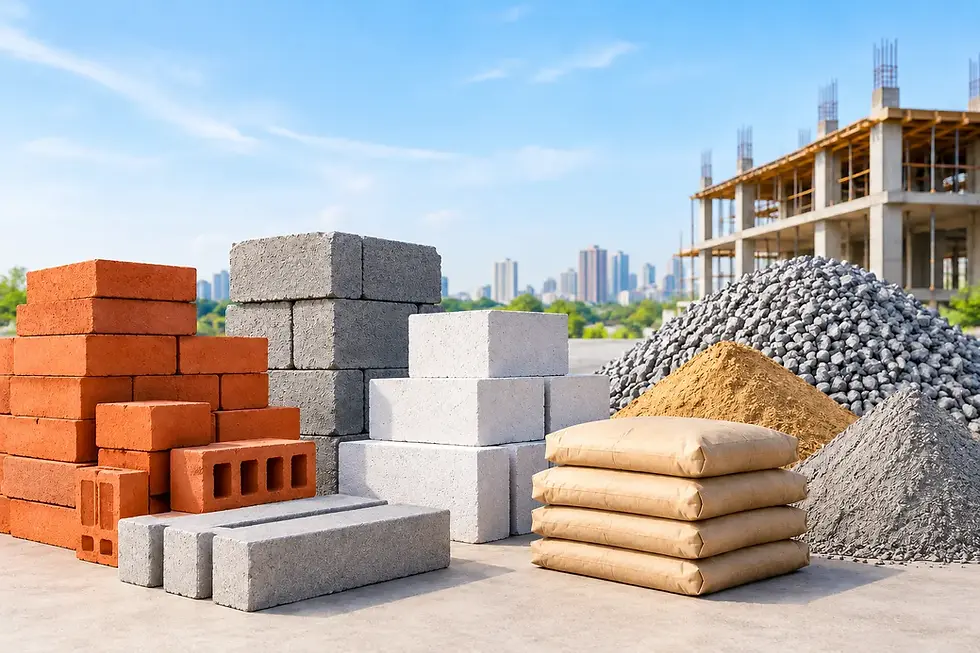
The real estate and construction landscape across the Delhi National Capital Region (NCR) is undergoing a massive transformation. From high-rise residential towers reshaping skyline corridors to independent floor developments and commercial hubs, construction methodologies are evolving rapidly. At the heart of every successful construction project—regardless of scale—lies the critical choice of foundational materials.
Selecting the right masonry units and aggregates directly impacts structural load, seismic resistance, thermal efficiency, project timelines, labor expenses, and overall lifetime maintenance costs. Today, architects, structural engineers, contractors, and individual home builders face a dynamic choice between traditional burnt clay bricks, engineered lightweight blocks, eco-friendly industrial alternatives, and fine riverbed aggregates.
This comprehensive guide delves into the technical specifications, structural advantages, application areas, and procurement dynamics of the essential building materials driving modern construction in Delhi NCR.
1. Traditional Excellence: Red Clay Bricks
For generations, burnt red clay bricks have served as the fundamental building block of Indian civil engineering. Produced by molding natural alluvial clay and firing it in continuous kilns at elevated temperatures, these units develop high density, impressive compressive strength, and time-tested durability.
Structural Performance and Thermal Efficiency
Red clay bricks are naturally dense, providing high load-bearing capacity suitable for foundational masonry, compound walls, and load-bearing multi-story structures without full concrete frames. Furthermore, clay possesses substantial thermal mass. In a region like Delhi, where ambient temperatures fluctuate drastically between intense summer heat waves and cold winter snaps, clay walls absorb heat during the peak of the day and release it slowly at night, creating a natural thermal buffer inside the building.
Quality Assessment and Procurement
When procuring clay units, quality control is paramount. Structural engineers classify clay bricks based on their compressive strength, water absorption rates, and dimensional consistency:
First-Class (Awwal) Bricks: Uniformly burnt with sharp edges, smooth rectangular faces, deep red color, and high crushing strength (typically above 10.5 N/mm2). They absorb less than 20% of their dry weight in water.
Second-Class Bricks: Slightly irregular in shape with minor surface cracks, suitable for internal partition walls where heavy plastering will cover imperfections.
Before finalizing your site estimates, keeping track of the current bricks rate in delhi ensures accurate budget allocation. Additionally, sourcing materials through established brick suppliers guarantees consistent First-Class quality with minimal transit breakage.
Primary Applications: Structural load-bearing walls, foundation masonry, boundary walls, and decorative exposed brick facades.
2. High-Efficiency Engineered Masonry: AAC Blocks
As urban construction shifts toward multi-story RCC (Reinforced Cement Concrete) framed structures, Autoclaved Aerated Concrete (AAC) blocks have gained widespread adoption across Delhi NCR. Invented to combine lightweight composition with structural durability, AAC blocks are manufactured from a steam-cured mixture of fly ash, cement, lime, water, and an aluminum expansion agent.
Dead Weight Reduction and Cost Optimization
The primary technical advantage of AAC blocks lies in their low density (typically 550 to 650 kg/m3), which is approximately one-third the weight of traditional red clay bricks (1800 to 2000 kg/m3).
This massive weight reduction translates into immediate structural savings:
Reduced Dead Load: Lower structural weight reduces the dead load on the building’s RCC frame, allowing engineers to optimize beam, column, and foundation dimensions.
Steel and Concrete Savings: Steel reinforcement requirements can drop by up to 10–15% in high-rise structures.
Faster Construction Speed: Because one standard AAC block replaces approximately 6 to 9 clay bricks, masonry execution is significantly faster, saving labor costs and reducing project completion timelines.
Mortar and Plaster Savings
AAC blocks feature sharp geometric corners and flat plane surfaces. Unlike uneven clay bricks that require thick mortar beds (12 to 15 mm), AAC blocks can be laid using thin-bed polymer mortars (2 to 3 mm thickness). Furthermore, their smooth surface eliminates the need for thick backing plaster, requiring only a thin finishing coat.
To optimize your project budget and structural specifications, check updated aac block bricks options, and review current aac block rates to match your architectural blueprints.
Primary Applications: Partition walls in high-rise residential buildings, commercial office towers, hospital frameworks, and exterior infill masonry in RCC structures.
3. Sustainable and Uniform: Fly Ash Bricks
With an increasing emphasis on green building certifications and sustainable resource utilization, fly ash bricks have emerged as a prominent choice for modern structural execution. Manufactured by mixing industrial fly ash (a by-product of thermal power plants) with cement, sand, and stone dust under high hydraulic compression, these units undergo controlled curing to achieve high density and uniform shape.
Key Performance Benefits
High Compressive Strength: Machine-pressed fly ash bricks exhibit uniform structural strength, regularly meeting or exceeding class designation 7.5 N/mm2 to 10 N/mm2.
Zero Salt Efflorescence: Traditional clay bricks often contain soluble salts that leach onto wall surfaces over time, creating unsightly white deposits (efflorescence) and damaging paint. Fly ash bricks contain no clay salts, eliminating efflorescence entirely.
Low Water Absorption: With water absorption rates typically below 12%, these units reduce moisture retention, preventing dampness and wall deterioration.
Buying directly from verified fly ash bricks manufacturers ensures consistent batch quality, exact geometric dimensions, and reliable compressive strength across large masonry projects.
Primary Applications: Exterior boundary walls, structural partition walls, residential apartments, and eco-friendly commercial developments.
4. Aggregates and Mortar Foundations: Yamuna Sand
A masonry wall or concrete slab relies on fine aggregates just as much as it does on bricks or cement. In Delhi NCR, fine river sand sourced from the Yamuna riverbed acts as the indispensable filler aggregate that binds cement particles into a cohesive structural matrix.
Why Sand Quality Matters
The quality of fine sand determines the workability, strength, and durability of both concrete and mortar mixes. High-grade sand must meet key criteria:
Low Silt Content: Silt and clay particles smaller than 75 microns coat the sand grains, preventing proper adhesion between the cement paste and aggregate. Silt levels above 8% significantly reduce concrete compressive strength and lead to surface cracking.
Optimal Grain Grading: Properly graded river sand contains a balanced range of particle sizes, reducing void space in concrete and masonry mortar.
Chemical Purity: River sand must be free from organic matter, alkalis, and salts that cause reinforcement corrosion or plaster blistering.
Utilizing clean, silt-tested yamuna sand ensures superior concrete density, crack-free plaster finishes, and maximum bond strength across all masonry joints.
Primary Applications: Structural RCC casting (slabs, beams, columns), bricklaying mortar mixes, internal/external plastering, and floor screeds.
Comparing Core Construction Materials
Material Type | Density (kg/m3) | Compressive Strength | Thermal Insulation | Primary Structural Advantage |
Red Clay Bricks | 1800−2000 | 7.5−10.5 N/mm2 | Good (High thermal mass) | Proven load-bearing strength and durability |
AAC Blocks | 550−650 | 3.0−4.5 N/mm2 | Superior (K-value ≈0.16 W/mK) | Light weight, fast installation, low structural dead load |
Fly Ash Bricks | 1700−1800 | 7.5−12.0 N/mm2 | Moderate | Dimensional precision, eco-friendly, zero efflorescence |
Yamuna Sand | 1450−1600 | N/A (Aggregate) | N/A | High cement bonding efficiency, optimal silt control |
Frequently Asked Questions (FAQs)
1. How do AAC blocks contribute to energy efficiency in Delhi’s climate?
AAC blocks possess a microscopic cellular structure filled with millions of tiny air pockets. This unique cellular matrix provides exceptional thermal insulation, resulting in a thermal conductivity (K-value) roughly one-third that of conventional clay bricks. During Delhi's scorching summers, AAC walling blocks heat transfer into the building interior, reducing HVAC cooling loads and cutting electricity costs by up to 25–30%.
2. Can fly ash bricks completely replace clay bricks in residential projects?
Yes. High-quality, machine-pressed fly ash bricks meet and often exceed the compressive strength standards required for load-bearing and non-load-bearing masonry walls. Because of their precise shape, uniform dimensions, and freedom from salt efflorescence, they are widely used as a direct, cost-effective substitute for traditional red clay bricks.
3. What is the impact of using high-silt sand in plaster and concrete work?
Sand containing excess silt (above 8%) absorbs water without participating in the cement hydration process. This results in weak, porous mortar that shrinks rapidly upon drying. Over time, high silt levels cause hairline cracks on plaster surfaces, hollow sounds behind finishes, peeling paint, and reduced bond strength between bricks and concrete frames.
Conclusion
Building a structural landmark or residential home in Delhi NCR requires balancing structural safety, environmental efficiency, and cost management. Each material plays a distinct, complementary role:
Red Clay Bricks provide proven thermal density and load-bearing permanence.
AAC Blocks deliver lightweight structural efficiency, rapid installation, and energy savings for multi-story buildings.
Fly Ash Bricks offer uniform, eco-friendly strength with zero efflorescence risk.
Yamuna Sand forms the clean, silt-free bonding foundation necessary for long-lasting mortar and RCC structures.
By matching material performance characteristics with your specific architectural engineering requirements, you ensure your project is built to stand the test of time. For transparent market rates, reliable bulk supply, and direct site delivery across Delhi NCR, connect with trusted industry partners like Chhikara Builders to keep your project moving forward seamlessly.


Comments